Home=Current Comets: C/2026 A1
| The German Group
| Tutorials
| Archive
| Projects, publications
| Images
| Contact
A member of the Kreutz group was discovered as the first comet of 2026 on Jan. 13 in the constellation Columba as part of the MAPS project. A total magnitude of 18.0 was determined via the images of comet C/2026 A1 (MAPS), with a diffuse coma of 12" diameter. Remote images taken by Michael Jäger and Gerald Rhemann on Jan. 18 showed a 2.5' coma of total brightness 16.1 mag. Subsequently, the comet could be tracked back to Dec. 18, 2025. This is the Kreutz comet that has been observed at the greatest solar distance to date. The comet will pass perihelion on Apr. 4, 2026 at a solar distance of only 0.0057 AU (CBET 5658). Assuming an average brightness development it could become as bright as –2 mag during a very short time, but it will then be positioned very close to the Sun. Thus it is more likely that only solar probes will be able to track its development during the days around perihelion.
However, its absolute magnitude is well below the Bortle limit. This means that there is a high probability that the comet will disintegrate while approaching the Sun. On the other hand, it is possible that it will not show an average brightness development, that its absolute brightness will increase significantly, and that it will then be able to reach or just survive perihelion. Examples are comets C/2006 P1 (McNaught) and C/2011 W3 (Lovejoy). Assuming an average brightness development the comet would be brighter than 16 mag until the end of May. During this period it will initially move retrograde from the constellation Eridanus to the constellation Pisces. Thereafter moving prograde from Pisces to Orion. It will remain virtually invisible from Central European locations. Only in the few days around perihelion could it possibly be spotted with binoculars or a telescope in the bright twilight, provided it actually becomes brighter than 0 mag for a short time. Possibly, forward scattering could be helpful, which could cause a brightness increase of more than 1 agm from 14hUT to 23hUT on Apr. 4, peaking at about 4.5 mag at 16hUT. If it survives its extreme proximity to the Sun attempts can be made to locate the comet in the bright evening twilight in the days around perihelion. Earth will cross the comet's orbital plane on March 29.
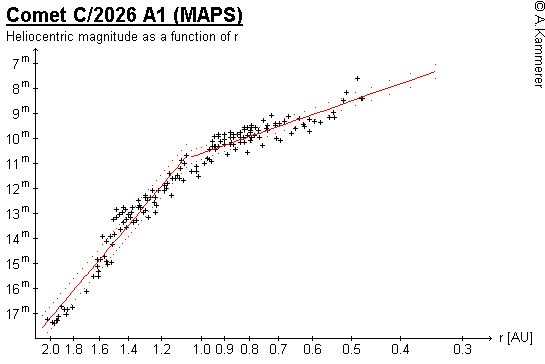
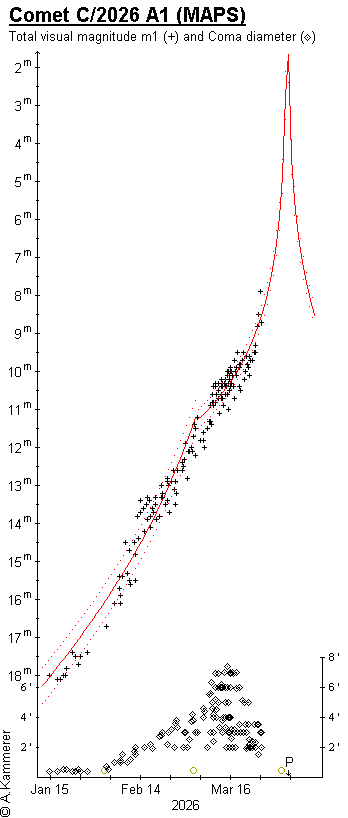
With much excitement was the development of the comet observed, as its absolute magnitude suggested it would disintegrate while approaching the Sun. After a rapid increase in activity up to 33 days before perihelion (Mar. 2, 2026), the activity increased at a significantly lower but remarkably steady rate thereafter. Based on 245 observations from 27 observers the following brightness parameters can be determined:
t < -33d: m0 = 10.0 mag / n = 9
Development of the heliocentric magnitude
According to Z. Sekanina it is very likely that Comet C/2026 A1 (MAPS) is a fragment of the extremely bright comet at the end of 363 AD, which was visible in the daytime. The significantly longer orbital period can be explained with the fragmentation taking place at a great distance from the Sun, well after the comet passed perihelion. Since the comet has a relatively small diameter, he expected it would break up near r = 0.2 AU. However, predictions are extremely difficult, as no Kreutz comet has yet been observed at such a great distance from the Sun (CBET 5663). According to CBET 5675 the orbital period, taking into account non-gravitational perturbations, is 1,740 years, so that the comet likely passed its last perihelion in the second half of the year 285 AD.
Actually the comet did not reach its perihelion intact. Its final hours were captured via SOHO images. The comet appeared in the C3 field on Apr. 2 at 15:45 UT, displaying a rather faint gas tail about 1° long. It brightened steadily until Apr. 4 at 07:00 UT, after which it was partially obscured by the occultation disk holder, so that brightness measurements grew to a subject of significant uncertainty. Around 09:30 UT it disappeared behind the disk at a position angle of 130°. By this time the tail had grown to a length of about 2°. The comet reached perihelion on Apr. 4 at 14:25 UT. The leading edge of the debris cloud appeared on Apr. 4 at approximately 20:30 UT at a position angle of 310° (i.e., directly opposite the entry position); its trailing edge emerged from behind the disk on Apr. 5 at 07:00 UT, giving it a length of about 1.5°. The debris cloud initially appeared very bright — due to short-term forward scattering. Starting around 07:00 UT the brightness began to decline; at the same time the cloud moved radially away from the Sun (but in the opposite direction of the comet's original orbit) and slowly expanded in the direction of propagation. The debris cloud was last reliably observed in the early hours of Apr. 7. At that time, it had an extent of about 2°. The comet appeared in the C2 field on Apr. 4 at 06:00 UT. Around 07:00 UT it reached its maximum brightness of –0.8 mag. Thereafter if faded significantly. Around 11:30 UT the comet's head disappeared behind the disk (p.a. 130°). Starting at 16:45 UT the debris cloud appeared at a position angle of 310°. Simulations by Z. Sekanina indicate that the comet broke apart over several hours, with this process concluding around 12:15 UT on Apr. 4. The debris cloud consisted of submillimeter-sized silicate particles whose motion was determined solely by the Sun's radiation pressure (CBET 5681).
Total Brightness and Coma Diameter
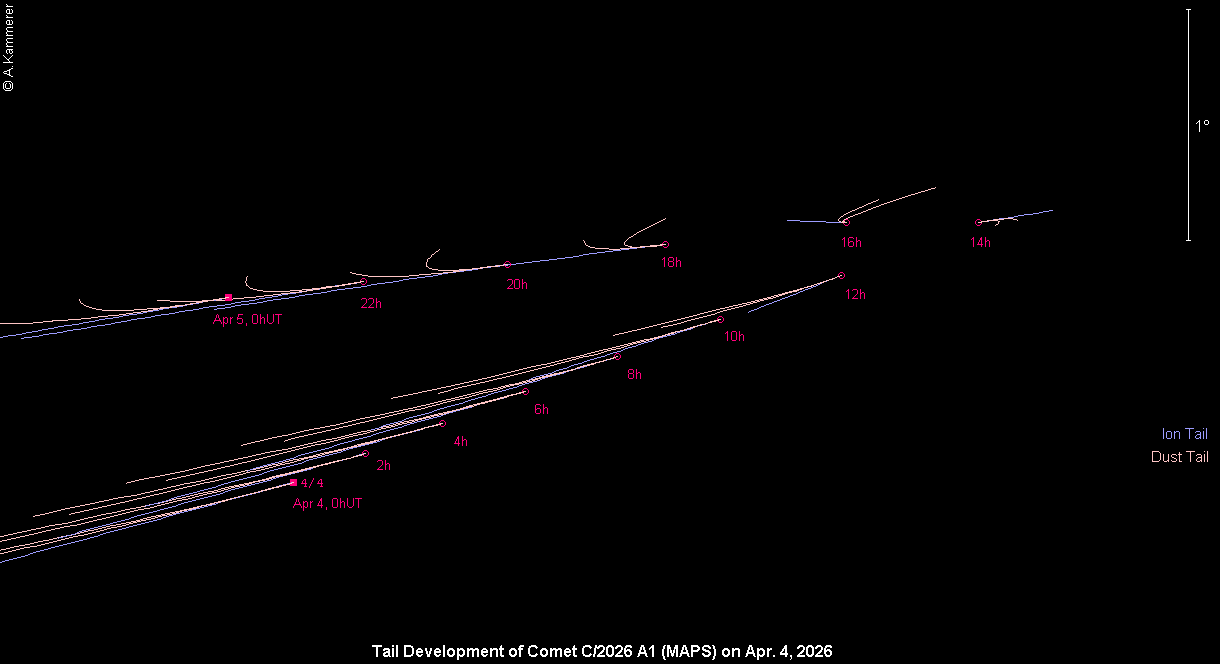
The coma diameter increased from 0.7' (30,000 km) at the start of the apparition to a maximum of 7' (375,000 km) in mid-March. It then decreased due to increasing radiation pressure, measuring only 1' (70,000 km) by the end of March. The degree of condensation increased from DC 3 to DC 6 between the first week of March and the end of March. A tail was observed starting in early February, but its length remained below 0.5° until around Mar. 25. The maximum length of 2.3° (8 mio. km) was reached on Apr. 4. During its apparition the position angle of the tail increased from 55° to 100°.If the comet would have survived perihelion it would have exhibited a very interesting tail morphology for several hours, as shown in the following graph. The simulated tail length has a higher degree of uncertainty, as my empirical formula has not been sufficiently tested for such small solar distances.
Simulation of the Tail Development on Apr. 4, 2026
Andreas Kammerer