Home=Current Comets: C/2024 E1
| The German Group
| Tutorials
| Archive
| Projects, publications
| Images
| Contact
On Mar. 3, 2024, Kacper Wierzchos discovered a comet with the 1.5m reflector on Mt. Lemmon. The comet, positioned in the constellation Draco, showed a strongly condensed, 4" coma of total magnitude 20.0-20.5 and a 6" tail in p.a. 320°. At a distance of 8 AU at discovery comet C/2024 E1 (Wierzchos) will not pass perihelion at a solar distance of 0.56 AU until Jan. 21, 2026, then predicted to peak around magnitude 7 (CBET 5364). However, at this time the comet will be on the opposite side of the Sun relative to Earth, thus being positioned close to the Sun, making observations very difficult. It should be brighter than 16 mag between June 2025 and July 2026. During this period it will move through the constellations Draco, Hercules, Corona Borealis, Hercules, Ophiuchus, Serpens, Sagittarius (perihelion), Microscopium, Grus, Phoenix, Sculptor, Cetus, Eridanus, Taurus and Gemini. From Central European locations it can be seen in the evening sky until the end of November 2025 (then only 11 mag) and then again between the end of February (about 8 mag) and mid-May 2026 (about 13 mag).
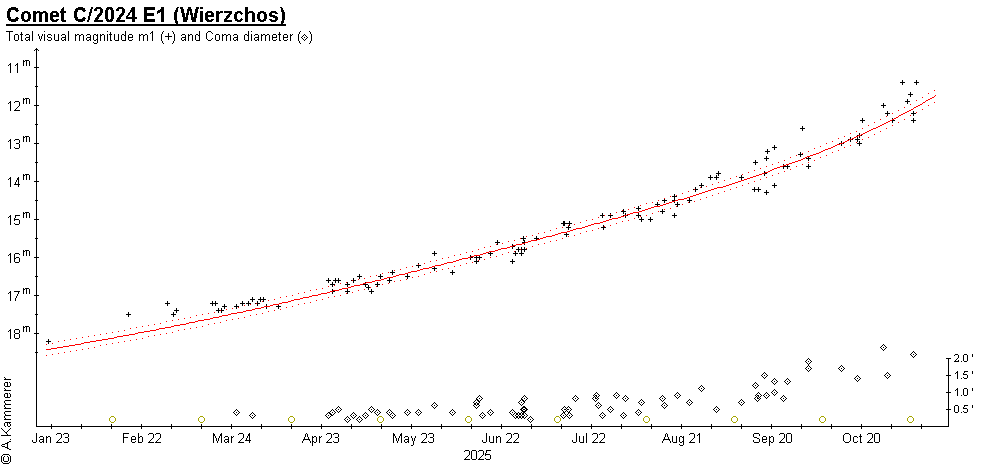
The comet showed a different development pre- and post-perihelion, with the activity declining more rapidly post-perihelion than it had increased pre-perihelion. Based on 399 observations by 64 observers the brightness development can be well simulated by the following parameters:
pre-perihelion : m0 = 8.7 mag / n = 3.4Thus the comet peaked at magnitude 6.4m on Jan. 25, 2026. While the near-nucleus region appeared somewhat brighter between Feb. 25 and Mar. 6 the comet began to fade much more rapidly starting on Mar. 6, and images taken from Mar. 12 onward showed clear signs of disintegration (CBET 5669). In mid-April 2026 the comet had faded to 13.5m. Meanwhile the comet is no longer observable.
Total Brightness and Coma Diameter
The apparent coma diameter measured 0.5' at the start of the apparition, then slowly increased during summer of 2025, reaching 1.5' by mid-November. Immediately after solar conjunction the maximum diameter of 5' was reached. By early April 2026 it had shrunk back to 1.5'. The absolute coma diameter measured 80,000 km at the start of the apparition, expanding to 200,000 km between summer 2025 and mid-November. Immediately after solar conjunction it measured 250,000 km, thereafter shrinking to 100,000 km by early April 2026. While the coma appeared quite diffuse in summer 2025 (DC 3) it was highly condensed immediately after solar conjunction (DC 7). During the following weeks it became steadily more diffuse (early April 2026: DC 1–2), due to the disintegration of the nucleus.Starting in spring 2025 a tail was observed via CCD. It reached a maximum visual length of 1.8° (5.5 mio. km) in early February 2026. In early April it measured 0.1°. Images in February 2026 showed a gas tail, at least 3° long and up to three dust tails, spanning over 90° in position angle. The latter can be interpreted as a first indication of the disintegration. While the tail significantly changed its orientation before solar conjunction (from Northwest through West, South, East to ENE), it pointed quite steadily in a southeasterly direction after solar conjunction.
Andreas Kammerer