Home=Current Comets
| The German Group
| Tutorials
| Archive: Fainter Comets 2025
| Projects, publications
| Images
| Contact
On June 6, 2025 the ATLAS team discovered a comet near the border of the constellations Eridanus/Horologium. Comet C/2025 L1 (ATLAS) exhibited a highly condensed, 1.5" coma with total magnitude 18.0 and a faint, 3" tail in p.a. 300°. It will pass perihelion at the solar distance of 1.68 AU on Jan. 12, 2026 and should reach a peak brightness of 14.0 mag in March 2026 (CBET 5566). It should be brighter than 16 mag from October 2025 to May 2026. During this period it will pass through the constellations Centaurus, Lupus (perihelion), Scorpius, Libra, Serpens (maximum brightness), Bootes and Canes Venatici. From Central European locations it will appear in the morning sky at the beginning of February 2029, thereafter quickly gaining high altitudes.
At perihelion the comet reached a brightness of 15.0 mag; the coma diameter was determined to be 0.5'.
--------------------
On Nov. 2, 2025, Gennadii Borisov discovered a comet near the border of the constellations Virgo/Crater, showing a 0.5' coma, for which he reported a total magnitude of 12.1. Follow-up observations of comet C/2025 V1 (Borisov) showed a strongly condensed coma up to 4' in size with a total magnitude of 10.5, but no tail. The comet will pass perihelion on Nov. 16, 2025, at a solar distance of only 0.46 AU and could then become as bright as 9.5 mag (CBET 5631). However, the determined absolute brightness is well below the Bortle limit, so there is a high probability that it will disintegrate on its way to perihelion. If it survives the perihelion passage it would be brighter than 16 mag until mid-January 2026. During this period it will move through the constellations Virgo, Serpens, Ophiuchus, Serpens, Scutum, and Aquila. From Central European locations it could only be seen low above the eastern morning horizon until mid-November and then low above the western evening horizon between mid-November and mid-December.
The comet did not reach perihelion. Images taken on Nov. 5 already showed it to be significantly fainter, and by Nov. 7 it was barely detectable. It was probably discovered during an outburst, as it appears about 5 mag fainter in pre-discovery images taken a few days before discovery. According to Michael Jäger the comet appeared 3 mag fainter on Nov. 8 than on Nov. 4 (Comet's Mailing List).
--------------------
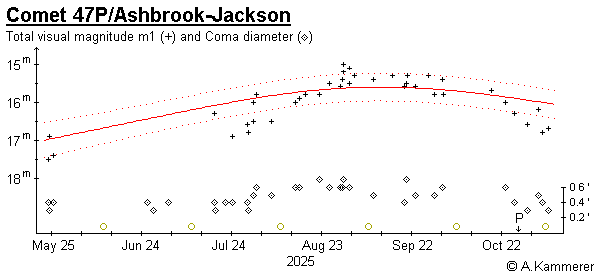
Comet 47P/Ashbrook-Jackson (P=8.36a) will pass perihelion at the solar distance of 2.81 AU on Oct. 27, 2025, but should reach its maximum brightness of 14.5 mag as early as September. For mid-European locations the comet will appear in the morning sky at the beginning of July.
The comet reached a maximum brightness of 15.5 mag in mid-September 2025, based on 46 CCD observations from 11 observers. The brightness parameters can be roughly deduced as: m0 = 5.2 mag / n = 8. However, the variance in the distance to the Sun over the apparition is very small, resulting in large uncertainties concerning the parameter values (for example, the parameters m0 = –1.5 mag / n = 14 give a very similar result!). The coma diameter reached a maximum of 0.6' (50,000 km). A tail pointing towards WSW with a maximum length of 3' (1.5 million km) was detected.Total Brightness and Coma Diameter
--------------------
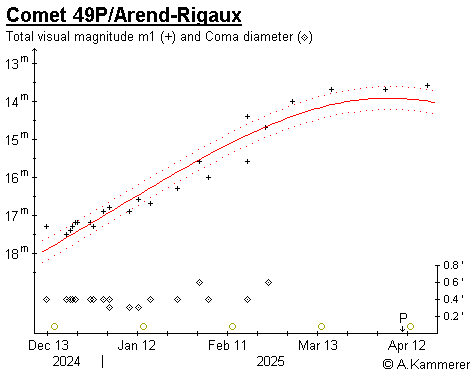
Comet 49P/Arend-Rigaux (P=6.74a) can be observed in the evening sky with large instruments until the end of April 2025. Thereafter it is too near the Sun for reasonable observations. It moves from the constellation Cetus into Taurus. The comet passes perihelion at the solar distance of 1.43 AU on Apr. 10, 2025.
The comet became somewhat brighter than expected and reached a maximum brightness of 13.8 mag at the beginning of April 2025, after having been only about 18 mag in mid-December 2024. On the basis of only 17 CCD observations the brightness development can be represented reasonably well with the parametersTotal Brightness and Coma Diameter
--------------------
Comet 65P/Gunn (P=7.68a) will pass perihelion at a solar distance of 2.93 AU on June 16, 2025 and could then reach a maximum brightness of around 15.0-15.5 mag. It is positioned in the southern part of the constellation Sagittarius, so it will be a very difficult object for mid-European locations.
Less than 20 CCD observations could I use for a very preliminary analysis. The brightness estimates can be represented reasonably well with the brightness parameters
m0 = 9.0 mag / n = 4.
Thus the comet reached a maximum brightness of about 15.0 mag in July 2025, and should become fainter than 16.0 mag already in October. The coma diameter measured about 0.5'.
--------------------
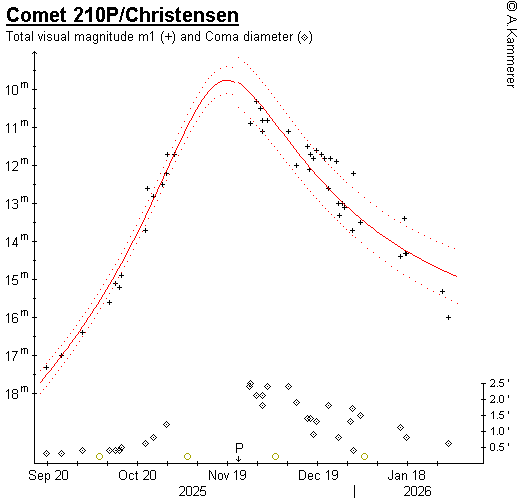
On Nov. 22, 2025 comet 210P/Christensen (P=5.62a) will once again pass perihelion at the solar distance of 0.52 AU.
Only 53 observations (mostly by CCD) from 15 observers can be used for the analysis. These show a significantly more rapid increase in activity pre-perihelion than the decrease post-perihelion. The maximum brightness of 9.6 mag was reached around Nov. 20, 2025, although the observed maximum brightnesses pre-perihelion were 11.7 mag (on Nov. 1) and 10.3 mag (on Nov. 28) post-perihelion. At the end of September 2025 the comet was of magnitude 17.0 and at the beginning of February 2026 of magnitude 15.0. The corresponding brightness parameters are:
pre-perihelion: m0 = 16.6 mag / n = 7.8
post-perihelion: m0 = 13.6 mag / n = 3.6
Total Brightness and Coma Diameter
--------------------
Comet 217P/LINEAR (P=7.83a) passed perihelion at the solar distance of 1.23 AU on May 24, 2025, but was quite close to the Sun for a long time. Starting in mid-August 2025 the comet can be seen in the morning sky from mid-European locations, but should already become fainter than 16.0 mag in November. During this period it moves from the southwestern part of the constellation Gemini to the eastern part of the constellation Cancer.
Due to the unfavorable conditions it is no wonder that just 25 CCD observations can be used for a very preliminary analysis. These can be simulated reasonably well with the brightness parameters
m0=10.0 mag / n=5.
The comet peaked at 12.5 mag at the end of June 2025. The diameter of the medium-condensed coma reached 0.7'. A short appendage towards West could be documented.
--------------------
Comet 496P/Hill (P=15.07a) = P/2010 A3 (Hill), which passed perihelion at a solar distance of 1.62 AU on March 10, 2025, reached a maximum brightness of about 15.0-15.5 mag at the end of March 2025. At the beginning of May it became fainter than 16 mag. The diameter of the moderately condensed coma reached about 1.5' (200,000 km).
Andreas Kammerer