Home=Current Comets: C/2025 T1
| The German Group
| Tutorials
| Archive
| Projects, publications
| Images
| Contact
An object of magnitude 16, discovered on Oct. 11, 2025 by the ATLAS project in the constellation Ursa Major, revealed its cometary nature during follow-up observations. Comet C/2025 T1 (ATLAS) showed a coma of 1.5-2.0' diameter with a total magnitude of 14.0 and a short, towards SSW pointing tail. The comet will pass perihelion at a solar distance of 1.11 AU on Dec. 2, 2025 and could reach magnitude 12.5 in mid-November (at perigee) (CBET 5624). It will remain brighter than 16 mag until the end of February 2026. During this period it will move through the constellations Ursa Major, Draco, Hercules (maximum brightness), Lyra, Vulpecula (perihelion), Sagitta, Aquila, Aquarius and Capricorn. From locations in Central Europe it can be seen in the morning sky until mid-November and in the evening sky until mid-January (then at about 14.5 mag), switching from the morning to the evening sky at the end of October.
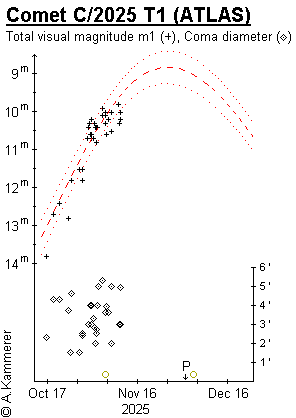
The comet showed a very different brightness behavior pre- and post-perihelion, as shown by 213 observations from 53 observers. According to these observations, the activity increased extremely rapidly pre-perihelion, while it declined significantly slower post-perihelion. At only 13.5 mag in mid-October it peaked at 9.1 mag already on Nov. 25, 2025. By the last decade of January 2026 it had faded to 11.0 mag and by the opening of May to 15.0 mag. The corresponding brightness parameters are:
pre-perihelion: m0 = 6.9 mag / n = 17
Total Brightness and Coma Diameter
The coma diameter increased from 4' (200,000 km) at the beginning of the apparition to the maximum of 5' (240,000 km) in mid-November 2025. By the beginning of January 2026 it had already decreased to 1.5' (125,000 km) and by the opening of May to 1' (125,000 km). Throughout the apparition the coma was only moderately condensed. Initially at DC 3, a degree of condensation of DC 4 was observed most of the time. A short tail pointing Northeast, reaching a maximum of 4' (300,000 km), could only be detected by CCD-observers.Andreas Kammerer