Home=Current Comets
| The German Group
| Tutorials
| Archive: C/2025 K1
| Projects, publications
| Images
| Contact
On May 24, 2025, the ATLAS team discovered an asteroidal object of magnitude 18.5 in the constellation Pegasus. Follow-up observations identified the object as cometary. Comet C/2025 K1 (ATLAS) showed a strongly condensed 15" coma and a faint, 11" tail in p.a. 255°. The comet will pass perihelion very close to the Sun (solar distance: 0.33 AU) on Oct. 8, 2025 and could then reach 9.5 mag. It will approach the Earth to within 0.58 AU on Aug. 13 and should then be of magnitude 12. However, its absolute brightness is well below the Bortle limit, so there is a high probability that the comet will disintegrate on its way towards perihelion (CBET 5557). If this should not happen the comet would be brighter than 16 mag between July 2025 and mid-January 2026, experiencing a second perigee of 0.40 AU on Nov. 25. During this period, it will move through the constellations Pegasus, Vulpecula, Hercules (1st perigee), Serpens, Libra, Virgo, Corvus (perihelion), Leo, Ursa Major (2nd perigee), Camelopardalis, Cassiopeia and Andromeda. From Central European locations it can be followed in the evening sky until the end of August (then of magnitude 12.0). If it survives the perihelion passage intact it will reappear in the morning sky around Oct. 20 (about 10.5 mag), quickly gaining altitude and finally moving towards the midnight sky.
This comet showed a very interesting development. Surprisingly it survived its close approach to the Sun, even though its absolute brightness was below the Bortle limit. At the beginning of June it was only of magnitude 17.0 but when it disappeared from the evening sky around Sep. 25 it showed as an object of magnitude 10.0. Would it survive perihelion? Starting around Oct. 25 the comet was recovered in the morning sky – showing a strongly condensed coma – at magnitude 9.5, making it a surprisingly easy object visually.
In the following weeks it developed into a miniature version of a fully developed comet with a small coma - showing a distinct central condensation - and a tail of several arcminutes length with a fairly high surface brightness. However, this high activity heralded its disintegration. At the turn of October/November a first fragment was detected with large instruments, and their number subsequently increased. The brightest fragment (designated C) could even be observed visually with larger amateur telescopes. What was special was that the comet was at high altitudes over many weeks, making observations of this very interesting development very comfortable.
Based on 434 observations by 68 observers the brightness development can be reasonably well represented with a classical brightness formula pre-perihelion, but a time-dependent formula has to be used post-perihelion, typical of a comet in disintegration:
pre-perihelion: m = 12.2 mag + 5×log D + 7.8×log rTotal Brightness and Coma Diameter (Main Component)
The apparent coma diameter increased from 0.4' at the start of the apparition to 1.6' in mid-August, which remained constant for several weeks. Post-perihelion the apparent coma diameter increased from 2.5' at the opening of November to the maximum of 3.5' at the end of November 2025. Until mid-January 2026 it had decreased to 0.3'. The absolute coma diameter measured rather constant 35,000 km until mid-August, thereafter expanded rapidly to 70,000 km by mid-September 2025. Post-perihelion the absolute coma diameter shrunk continuously. Whereas it measured 80,000 km at the start of November 2025 it had shrunk to just 20,000 km by mid-January 2026. The coma was noticeably condensed for most of the apparition. Pre-perihelion the degree of condensation was rather constant at DC 4. During the first weeks after perihelion the coma was significantly condensed (DC 5-6), but starting at the end of November 2025 it got more and more diffuse. At the start of January 2026 the degree of condensation was just DC 0-1.
Pre-perihelion a tail could always be recognized on CCD images. It reached a length of 12' in mid-August. Post-perihelion the tail was easily discernible visually for several weeks with a length of up to 0.6° (850,000 km) in mid-November 2025. While the tail was directed toward WSW at the beginning of the apparition it rotated rapidly over South towards East between the end of July and mid-August. Post-perihelion it was directed towards WNW at first, rotating rapidly towards East between end of November and start of December, eventually being directed towards ENE.
FGK observations (Main Component)
Observations with the Hubble Space Telescope showed an increase in brightness of the near-nucleus region of 0.3 mag on the night of Oct. 31/Nov. 1 and of 0.9 mag on Nov. 4. The latter can just be discerned in the moving weighted 3-day means of the total magnitude (amplitude appx. 0.5 mag). As a result of this short-term outbursts an image taken on Nov. 8 showed four fragments in p.a. 197°, with the two brightest ones separated by 3.6", exhibiting parabolic comae. The other two fragments showed at a greater distance from the nucleus and looked quite diffuse (ATel 17482 and 17488). Three fragments could be tracked with Earth-based telescopes in mid-November, with the two brightest also visible visually.
Observations with the Gemini North telescope on Nov. 11 showed three fragments lined up along p.a. 290°. The western one was separated by 5" and the eastern (faintest) one by 2" from the brightest middle fragment. The two brightest fragments each showed comae and tails. On Nov. 16 three fragments of approximately equal brightness (aligned along p.a. 285°) were visible, all of which had comae and tails, and a faint fourth fragment. The distances from the eastern fragment (probably the brightest one of Nov. 11) were measured as 6.0" and 13.4", while the fourth, faint fragment was 1.0" away from the central fragment. The eastern fragment was clearly elongated, indicating progressive fragmentation (ATel 17501). On Dec. 6 a short-lived fragment E was discovered.
According to Nick James fragment B separated from the main component A on Nov. 12. Fragment C appeared, trailing A, around Nov. 15. Fragment B separated around Nov. 23. By Nov. 26 C had almost disappeared, but fragment D appeared between A and C. By Nov. 30 D had become the brightest fragment. On Dec. 3 A and C were similarly bright, with D being the brightest fragment. D then faded, whereas C got brighter; on Dec. 5 C was the brightest fragment. By Dec. 8 D had almost disappeared, C was the brightest fragment, and A was becoming fainter.
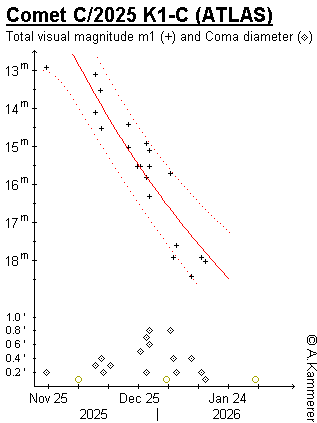
Based on 23 observations from 10 observers the brightness development of component C can be described with the formula
m = 11.2 mag + 5×log D + 0.053×|t - T|.Total Brightness and Coma Diameter of Fragment C
Andreas Kammerer