Home=Current Comets: C/2025 A6
| The German Group
| Tutorials
| Archive
| Projects, publications
| Images
| Contact
An asteroidal object discovered on Jan. 3, 2025 with the 1.5m reflector on Mt. Lemmon near the borders of the constellations Gemini/Cancer/Canis Minor displayed cometary morphology in follow-up observations. Comet C/2025 A6 (LEMMON) showed a coma of only 2" diameter with a total magnitude of 20.5. The comet will pass perihelion at the solar distance of 0.53 AU on Nov. 8, 2025, expected to reach magnitude 10.5. On Oct. 21 it will pass Earth at a distance of 0.60 AU at about the same brightness (CBET 5508). The comet should be brighter than 16 mag between early September 2025 and mid-January 2026. During this period it will pass through the constellations Gemini, Lynx, Leo Minor, Ursa Major, Canes Venatici, Ursa Major (perigee), Serpens (perihelion) and Scorpius. From mid-European locations it reaches its greatest altitude in the morning sky at around 40° at the end of September and disappears from it around Oct. 20. In the evening sky it can be seen between the first week of October and the first week of November, reaching a maximum altitude of 25°.
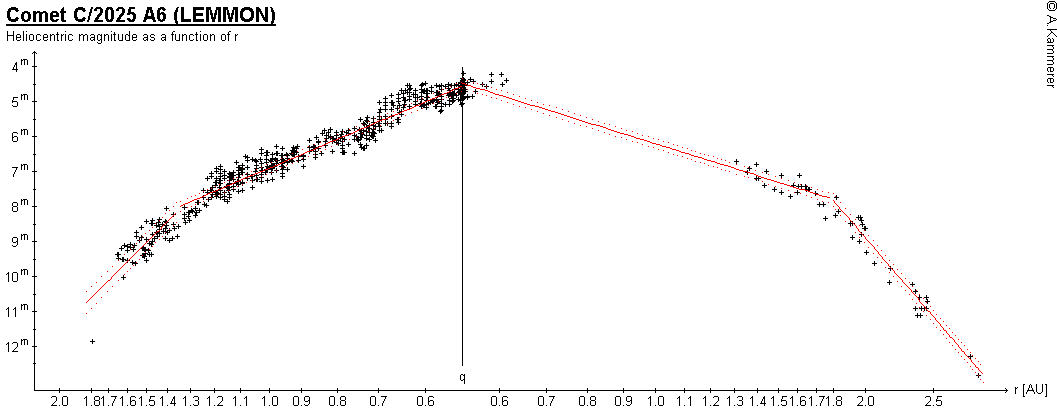
The comet became the most interesting comet in autumn and the second brightest of 2025. It was intensively observed, although the weather in Central Europe was anything but cooperative. When it reappeared in the morning sky around Aug. 10 the comet was significantly brighter than expected (CBET 5594). Based on 865 observations by 88 observers the period of high activity during the first weeks ended around Sep. 15 (55 days prior to perihelion). At the start of January 2026 the comet reappeared in twilight for observers in the Southern hemisphere. During the first weeks its activity decreased only slowly, but after Jan. 28 (80 days after perihelion) the activity dropped rapidly. The appropriate brightness parameters are as follows:
t < -55d: m0 = 5.8 mag / n = 7Development of the heliocentric magnitude
According to these parameters the comet peaked at magnitude 4.1 on Oct. 28. However, the observations clearly indicate a maximum brightness of 3.8 mag on Oct. 25, 2025, indicating a small temporary brightening during these days. At the start of January 2026 the comet was of magnitude 8.5, fading to 9.5 mag until mid-February and to 16.0 mag at the start of June.
Total Brightness and Coma Diameter
Between mid-August and mid-October 2025 the apparent coma diameter increased from 1' to the maximum of 11'. By Nov. 10 it had decreased to 5'. It measured short of 4' after the conjunction with the Sun, decreasing to 0.5' until the start of June. In absolute terms the coma expanded from just under 100,000 km in mid-August to the maximum of 500,000 km around Sep. 25, 2025. Thereafter it shrunk to 300,000 km around Oct. 20, a value that was fairly constant until early November. After the conjunction with the Sun it measured 350,000 km, shrinking to 80,000 km until the start of June. As it approached the Sun the coma condensed significantly from DC 3 in mid-August to DC 7 at the end of October 2025. By Nov. 10 the coma was still strongly condensed (DC 6-7). After the solar conjunction its degree of condensation decreased from DC 5-6 to DC 1. Observations at the Teide Observatory at the end of September showed an exceptionally active nucleus with several jets directed towards the Northeast and Southwest (ATel 17450).Development of the Tail Length
Between the end of August and the end of November 2025 an ion tail, which was also well recognizable visually, could be observed. Around Oct. 25, 2025 it reached the maximum visual length of 5° (8 mio. km). By Nov. 10 it had shrunk to 1° (2.5 mio. km). After solar conjunction 0.1° have been reported. Initially pointing WNW the tail rotated noticeably toward North starting around Oct. 10, reaching an easterly orientation around Nov. 10. After conjunction with the Sun the tail pointed towards Southwest. In a photograph, taken with a 135 mm telephoto lens by Michael Jäger and Gerald Rhemann on Oct. 4, a tail length of 12° is documented (CBET 5621).
Andreas Kammerer