Home=Current Comets: 3I
| The German Group
| Tutorials
| Archive
| Projects, publications
| Images
| Contact
On July 1, 2025 the ATLAS team discovered an asteroidal object of magnitude 17.5 in the constellation Sagittarius, which moves on a highly hyperbolic orbit (e=6.14!). Additional observations showed a strongly condensed, tiny coma and a 4" tail in p.a. 280°. Comet C/2025 N1 (ATLAS) will pass perihelion on Oct. 29, 2025 at the solar distance of 1.36 AU and could reach a maximum brightness of 12.5 mag in mid-November (CBET 5578). It is the 3rd discovered interstellar object, which is why this second interstellar comet was given the permanent designation 3I/ATLAS. It is expected to be brighter than 16 mag between the beginning of August 2025 and the end of January 2026. During this period, it will move through the constellations Bootes, Scorpius, Libra, Virgo (perihelion), Leo and Cancer. From Central European locations it appears in the morning sky in mid-November and quickly gains altitude during the following weeks. At the end of January it can be observed throughout the night.
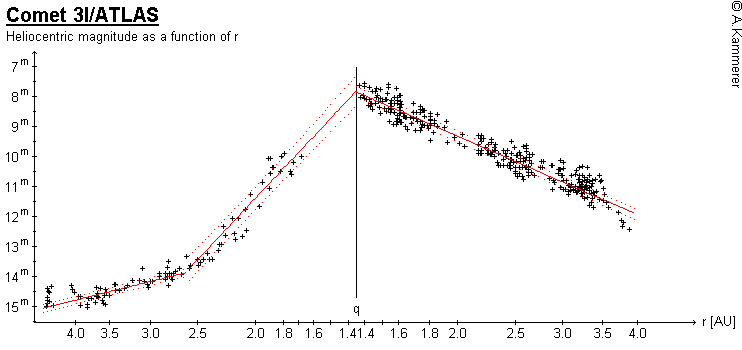
Due to a rapid increase in activity during the 60 days before perihelion, the comet reached a maximum brightness of 9.5 mag, making it 3 magnitudes brighter than originally predicted. Thus it could be seen even in smaller instruments. A total of 491 observations by 61 observers show a slow increase in activity until Aug. 30 (60 days before perihelion). In the following 60 days the activity increased rapidly. Post-perihelion the comet showed a very steady but significantly slower decline in activity.
Development of the heliocentric magnitude
As a result the comet was brighter than 16 mag between September 2025 and Februar 2026, much longer than originally predicted. The appropriate brightness parameters are: t < -60d: m0 = 11.8 mag / n = 2Of magnitude 17.5 at the beginning of July 2025 it brightened to just 16.0 mag by August 30. But thereafter a rapid increase in activity followed, with the comet reaching magnitude 12.0 by the time it disappeared in early October. The maximum brightness of 9.5 mag was finally reached in the first days of November 2025. At the beginning of February 2026 the comet was still of magnitude 14.0. It got fainter than 16 mag at the opening of March.
Total Brightness and Coma Diameter
The comet's diameter was just 0.3' (35,000 km) until September 2025. By the beginning of October it had increased to 1.0' (110,000 km). The maximum of 4.0' (350,000 km) was reached in the last week of November 2025. Thereafter it shrunk very steadily, measuring only 0.8' (110,000 km) at the beginning of February 2026 and just 0.3' (50.000 km) at the start of March. The coma was significantly condensed (DC 5) until the end of November, showing a significant central condensation. Thereafter it became steadily more diffuse (end of January 2026: DC 2-3), but the central condensation could still be detected until the end of the visual apparition.Only a few visual tail sightings were reported. CCD observers observed a tail between September 2025 and mid-March 2026 that reached a maximum length of 6' and pointed eastward.
Images taken by Michael Jäger in mid-August showed a faint fan of material in the direction of the Sun, which was confirmed by HST images taken on July 21 (CBET 5596). An Italian group used a simulation to determine that the center of activity is located at high latitudes on the sunward side (ATel 17350). On Sep. 7 (r = 2.33 AU) a production rate (molecules/s) of HCN of 1.5×1025 was determined. On Sep. 14 (r = 2.13 AU) the following production rates were determined: H2O: 1×1028, HCN: 4.5×1025 (CBET 5608). Radio observations between Oct. 13 and 19 determined an OH production rate of 5.7×1028 molecules/s (CBET 5625). On Oct. 20 (r = 1.39 AU), lines of CH3OH appeared with a production rate of 4.2×1027 molecules/s.
After solar conjunction the comet displayed a complex tail morphology, as can be seen in images taken by Michael Jäger, Gerald Rhemann, and E. Prosperi. On Nov. 8 (at an altitude of just 7-10°) they observed the following tails or jets: Length = 400" in p.a. 0°, 500" in p.a. 316°, 900" in p.a. 295°, 430" in p.a. 278° and 200" in p.a. 109°. Numerous images, including those taken by other observers, showed a gas tail in the anti-solar direction more than 1° long and a short anti-tail of dust particles pointing toward the Sun.
No non-gravitational forces could be detected. The comet will pass Jupiter on March 16, 2026 at a distance of 0.36 AU (CBET 5640). For the first time an interstellar comet was detected in the X-ray band (CBET 5646). It is estimated that the nucleus has a diameter between 450 m and 750 m. Gas production rates (molecules/s) determined on Nov. 29 (t = +31d, r = 1.76 AU): OH = 1.7×1028, CN = 5.5×1025, C2 = 6.1×1025, NH = 2.3×1025, dust: Af(rho) = 4660 cm (ATel 17515). Spectroscopic observations of the comet aboard the JUICE probe on Nov. 2, 2025 (t = +4d, r = 1.36 AU) revealed water with a production rate of 6.6×1028 molecules/s (ATel 17726). On Dec. 22, 2025 (t = +53d, r = 2.34 AU), the following production rates were observed: CN: 6.5×1026, C3: 7.0×1024, C2: 2.4×1026 (ATel 17719).
Andreas Kammerer