Home=Current Comets: Fainter Comets
| The German Group
| Tutorials
| Archive
| Projects, publications
| Images
| Contact
An asteroidal object of magnitude 22, discovered already on Oct. 20, 2014 by G. Bernstein and P. Bernardinelli with the 4.0m reflector of the Cerro Tololo Interamerican Observatory, displayed cometary activity in mid-June 2021. Comet C/2014 UN271 (Bernardellini-Bernstein) showed an 8" coma of total magnitude 19.5, asymmetric towards p.a. 40°. The comet will pass its extremely distant perihelion on Jan. 22, 2031 at the solar distance of 10.95 AU and could then reach magnitude 16-17 (CBET 4983/89).
In spring 2026 the comet was of magnitude 14.8, showing a 0.8' coma, but no tail. Based on 78 observations from 6 observers the brightness development can be well represented by the parameters
m0 = 0.5 mag / n = 3. This suggests that the comet will reach a maximum brightness of about 13.5 mag between 2030 and 2032. If the comet continues to develop in this way it would be brighter than 16.0m between mid-2023 and mid-2038. During this period it moves from Hydrus towards Centaurus (perihelion) and thereafter through the constellations Hydra, Corvus, Virgo, Coma Berenices and Canes Venatici. From mid-European locations meaningful observations are possible not before start of 2032.Total Brightness and Coma Diameter
--------------------
An asteroidal object of magntiude 19, which was already discovered on Apr. 21, 2021 by the ATLAS-Team in the constellation Canis Major showed faint cometary signatures during follow-up observations. Until October 2021 additional observations clearly confirmed the cometary nature. Comet C/2021 G2 (ATLAS) will pass perihelion on Sep. 9, 2024 at the solar distance of 4.98 AU, expected to reach magnitude 15.0 in spring 2024 and 2025 (CBET 4988/5057). It should be brighter than 16 mag between November 2023 and August 2025. During this period it moves through the constellations Hydra, Corvus, Virgo and Libra. From mid-European latitudes it will appear in December 2024 above the southeastern morning horizon, and will change into the evening sky in May 2025.
Based on 407 observations from 39 observers the comet showed a slightly different development pre- and post-perihelion, with an activity parameter slightly above average. The appropriate brightness parameters are:
pre-perihelion: m0 = 2.5 mag / n = 4.6 post-perihelion: m0 = 2.1 mag / n = 4.6 Thus the comet reached its peak brightness of about 13.5 mag at the beginning of May 2025, after it had already become 13.9 mag bright at the end of April 2024. By the end of September 2025 the comet had faded to 15.0 mag, by the end of July 2026 to 16.0 mag.Total Brightness and Coma Diameter (standard time scale)
Total Brightness and Coma Diameter (compressed time scale)
After the coma diameter increased from 0.6' (130,000 km) at the beginning of 2024 to 1.1' (210,000 km) in April, it decreased to 0.6' (175,000 km) by the end of August. After perihelion the apparent coma diameter increased from 0.8' to the maximum of 1.4' (May 2025), thereafter decreasing to 0.8' by the end of September and to 0.5' by the start of 2026. Post-perihelion the absolute coma diameter increased from 200,000 km to the maximum of 250,000 km (May 2025), thereafter decreasing to 225,000 km at the end of September and to 160,000 km by the start of 2026. The degree of condensation increased from DC 4-5 at the beginning of 2024 to DC 6 in May 2024. Until spring 2025 it had decreased to DC 3-4. A tail, pointing constantly in westerly directions, was observed throughout the entire apparition. It was 3' (4 mio. km) long in 2024 and showed a length of 9' (12 mio. km) in 2025.--------------------
On July 4, 2022 the PANSTARRS team discovered a comet of magnitude 20 in the constellation Sagittarius. Comet C/2022 N2 (PANSTARRS) showed a condensed 2" coma and a 3" tail in p.a. 260°. It will pass perihelion at the solar distance of 3.84 AU on Aug. 3, 2025, expected to peak at magnitude 14.5 in October/November 2025 (CBET 5148). At discovery it was still at a distance of 9.5 AU from the Sun! Between April 2025 and February 2026 it should be brighter than 16 mag. During this period it moves from central Pisces northeastward to the region near the border of the constellations Aries/Taurus. Thus the observing conditions are optimal for mid-European locations during the time the comet is brightest.
The comet peaked at 13.8 mag at the opening of November 2025, after reaching an initial maximum of 14.9 mag in October 2024. Based on 427 observations (mostly per CCD) by 45 observers the following brightness parameters simulate the brightness behavior rather well:
m0=7.0 mag / n=3Total Brightness and Coma Diameter (standard time scale)
Total Brightness and Coma Diameter (compressed time scale)
The apparent diameter of the rather diffuse coma increased from 0.4' at the beginning of the apparition to 0.7' in fall 2024. From August to mid-November 2025 it increased from 0.7' to the maximum of 1.6', thereafter slowly decreasing. Thus, the absolute coma diameter increased only slightly from 135,000 km to 150,000 km in 2024, but reached a maximum of 225,000 km in mid-November 2025. A tail, pointing constantly toward WSW, could be detected on CCD images throughout the entire apparition, reaching a maximum length of 7' (8 mio. km) in fall 2025.--------------------
Comet C/2022 QE78 (ATLAS), which passed perihelion at the solar distance of 5.48 AU on Sep. 10, 2025, became brighter than originally expected, as 316 observations (mostly via CCD) from 41 observers indicate. Between September 2024 and end of January 2025 the comet brightened from 16.0 mag to a first maximum of 15.1 mag (originally a peak brightness of about 16.5 mag was expected). The brightness development can be well described with the parameters
m0=0.3 mag / n=6. Thus the comet peaked at 14.7 mag in mid-January 2026. By the start of July 2026 it had faded to 16.0 mag. The coma diameter increased only from 0.6' (130,000 km) in 2024/25 to 0.7' (150,000 km) in 2025/26, with the coma medium-condensed (DC 5). Starting at the turn of 2024/25 CCD observers documented a short tail, which reached a length of 5' (about 8 Mio. km) at the opening of 2026.Total Brightness and Coma Diameter
--------------------
The PANSTARRS team discovered another comet on Sep. 7, 2023 near the border of the constellations Pisces/Andromeda. Comet C/2023 R1 (PANSTARRS) showed a 1.5" coma of total magnitude 19.5. It will not pass its mid-distance perihelion at the solar distance of 3.57 AU until Apr. 14, 2026 (then expected to be of magnitude 15) and should peak at 14 mag in June 2026 (CBET 5293). It should be brighter than 16 mag between July 2025 and October 2026, when it will move through the constellations Pegasus, Vulpecula, Sagitta, Aquila (perihelion), Scutum, Serpens Cauda, Ophiuchus, (maximum brightness), Serpens Caput and Libra. From Central European locations it can be followed until September 2026 - with the exception of the period from mid-December 2025 to the end of January 2026.
So far the comet shows a very steady development, however with a high activity parameter. Based on 250 observations (mostly by CCD) from 40 observers (until the end of July 2026) the brightness development can be well represented by the parameters
m0=-0.5 mag / n=8.5. Thus the comet was at magnitude 15.3 at the beginning of September 2025, reaching maximum brightness of 13.3 mag in early July 2026. After showing a maximum coma diameter of 0.6' (90,000 km) in 2025, it reached the absolute maximum of 1.2' (135,000 km) in 2026. The coma appears to be becoming slowly but steadily more diffuse. The degree of condensation was DC 5–6 until April 2026 but decreased to DC 4–5 by mid-July. In 2025 CCD observers did only rarely detect a tail, but in June/July 2026 tail sightings were frequently reported by them. However, its length was just short of 2' (about 700,000 km). So far, the tail is directed towards East.Total Brightness and Coma Diameter
--------------------
On May 6, 2024 the ATLAS team discovered a comet near the border of the constellations Sagittarius/Corona Australis. Comet C/2024 J3 (ATLAS) showed a highly condensed 9" coma of total magnitude 17.5 and a 12" tail in p.a. 220°. This comet will not pass perihelion at the solar distance of 3.86 AU until Nov. 24, 2026, expected to reach magnitude 13.0 (CBET 5398). It should be brighter than 16 mag between April 2025 and May 2028. During this period it will pass through the constellations Sagittarius, Scutum, Aquila, Delphinus, Vulpecula, Cygnus, Lyra (perihelion), Cygnus, Cepheus, Cassiopeia, Camelopardalis and Auriga. From Central European locations it should be observable from April to November 2025 (first in the morning sky, at the end in the evening sky), and then continuously from February 2026 to May 2028. The Earth will cross the comet's orbital plane every Jan. 7 and July 8.
Based on 161 observations (mostly by CCD) from 30 observers (until the end of July 2026) the comet shows a steady development so far, but with the activity increasing very slowly. This development can be well decribed by the parameters
m0 = 7.6 mag / n = 2.4 Thus the comet should reach a maximum brightness of 13.9 mag in early August 2026. However, the variance in the solar distance is still rather small, resulting in a greater uncertainty of the parameter values. While the coma diameter measured 0.5' (100,000 km) in 2025, it reached 0.7' (125,000 km) in 2026. With a degree of condensation of DC 4, the coma is moderately condensed. Observations of the tail, which points towards SSW, have been rare so far and have not exceeded a length of 2' (1.5 mio. km).Total Brightness and Coma Diameter
--------------------
On Sep. 11, 2024, the PANSTARRS team discovered a faint comet in the constellation Pegasus. Comet C/2024 R4 (PANSTARRS) exhibited a strongly condensed 4" coma of total magnitude 20.5 mag, but no tail. The comet will not pass perihelion at a solar distance of 4.41 AU until Oct. 28, 2027, when a brightness of 16 mag was initially predicted.
As of late July 2026 less than 20 CCD observations of the comet are available for a very preliminary analysis. These can be represented best by the rough parameters
m0 ≈ 0.0 mag / n ≈ 6 yielding a maximum brightness of 13.0 mag in early 2028! However, it is very likely that further observations will significantly alter these parameter values. The apparent diameter of the moderately condensed coma was less than 0.5' in July 2026. Between mid-August and mid-November the comet will travel westward through the constellation Cygnus; it can thus be observed throughout the night at first, and later in the evening sky at high altitudes. It should brighten from 15.0 mag to 14.5 mag. Earth will cross the orbital plane on Sep. 9.--------------------
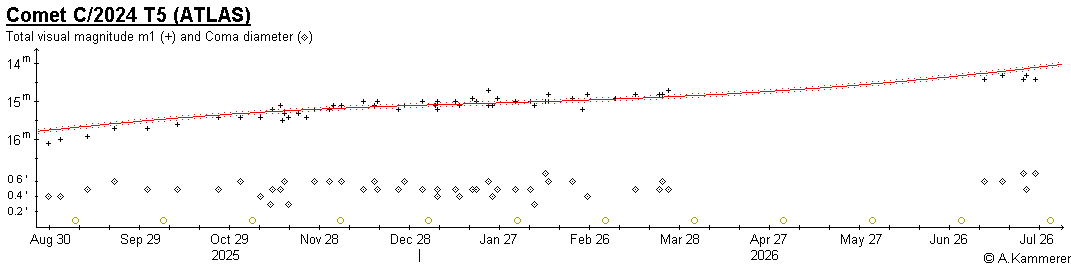
An asteroidal object of 19th magnitude, discovered by the ATLAS project on Oct. 2, 2024 near the border of the constellations Phoenix/Eridanus, revealed its cometary nature during follow-up observations. Comet C/2024 T5 (ATLAS) showed a stellar central condensation surrounded by an extremely diffuse 11" coma of total brightness 18.5 mag. The comet will not pass perihelion at the solar distance of 3.85 AU until May 7, 2027. It could reach 14.0 mag at the turn of the years 2026/27 (CBET 5472). Between May 2026 and May 2028 the comet should be brighter than 16 mag. During this period it will move through the constellations Eridanus, Lepus, Orion, Taurus (perihelion), Gemini, Cancer, Lynx and Ursa Major. For Central European locations it will appear in the morning sky in September 2026 and disappear from the evening sky in April 2027. The second apparition begins in August 2027. Thereafter the comet can be easily tracked until it fades below 16 mag.
So far the comet has shown a very steady development, reaching magnitude 14.0 at the end of July 2026. Based on 57 CCD observations from 9 observers its brightness development can be very well described by the parameters
m0 = 4.8 mag / n = 3.5. This yields a maximum brightness of 12.5 mag in early January 2027. The diameter of the moderately condensed (DC 4) coma has so far remained constant at 0.6' (140,000 km). A tail, directed towards Southwest, has been observed since the start of the apparition.Total Brightness and Coma Diameter
--------------------
On May 23, 2025 the PANSTARRS project discovered a comet near the border of the constellations Cygnus/Draco. Comet C/2025 K3 (PANSTARRS) showed a strongly condensed coma measuring only 1" with total magnitude 21.0 and a 2" tail in p.a. 170°. The comet will not pass perihelion at the solar distance of 3.46 AU until Dec. 14, 2028. It should reach 15.5 mag in spring 2028 and peak at 14.0 mag in February 2029 (CBET 5564). It should be brighter than 16 mag between February 2028 and August 2029. During this period it will move through the constellations Bootes, Canes Venatici, Ursa Major, Leo, Virgo, Crater (perihelion), Hydra (maximum brightness) and Pyxis. From Central European locations it can initially be observed at high altitudes throughout the night, but will disappear above the western evening horizon in July. At the end of October 2028 it reappears in the morning sky at significantly lower altitudes and can then be followed at low altitudes until the end of April 2029.
--------------------
On June 22, 2025 the PANSTARRS team discovered a 19th magnitude comet in the constellation Capricornus. Comet C/2025 M2 (PANSTARRS) showed a strongly condensed coma measuring just 1.5". It will pass perihelion on Nov. 26, 2027 at a solar distance of 2.73 AU and could reach a maximum brightness of about 12.5 mag in March 2028 (CBET 5576). It would be brighter than 16 mag between January 2027 and February 2029, during which time it will pass through the constellations Sagittarius, Scorpius, Libra, Virgo (perihelion and maximum brightness), Leo and Cancer. From Central European locations it can be followed between March and August 2027, between December 2027 and May 2028 and finally between September 2028 and February 2029.
--------------------
On Nov. 2, 2025, David Rankin of the Lunar and Planetary Laboratory discovered a comet of magnitude 19.5 in the eastern part of the constellation Leo. Comet C/2025 V2 (Rankin) showed a strongly condensed 5" coma, but no tail. The comet will not pass perihelion at a solar distance of 1.95 AU until March 23, 2027, and should reach a maximum brightness of 13.5 mag in May 2027. It should be brighter than 16 mag between October 2026 and October 2027. During this period it will move through the constellations Coma Berenices, Bootes, Serpens, Hercules/Ophiuchus (perihelion), Sagitta (maximum brightness), Aquila and Sagittarius. From Central European locations it can be observed in the morning sky between November 2026 and June 2027. Thereafter it will initially be observable throughout the night and will eventually end its visibility in the evening sky. The Earth will cross comet's orbital plane on Feb. 7 and Aug. 11, 2027.
--------------------
On Dec. 26, 2025 the ATLAS team discovered a stellar object with a magnitude of 18.5 in the constellation Virgo, moving along a nearly parabolic orbit. By late January 2026 images revealed a highly condensed 8" coma of total magnitude 17.5 and a 10" tail at p.a. 280°. Comet C/2025 Y1 (ATLAS) will pass perihelion at a solar distance of 2.60 AU on Oct. 13, 2027, expected to reach a maximum brightness of 12.0 mag in summer 2027 (CBET 5671). It would be brighter than 16 mag between August 2026 and December 2028. During this period it will move through the constellations Virgo, Libra, Serpens, Ophiuchus (maximum brightness), Serpens (perihelion), Scutum, Sagittarius, Capricornus, Aquarius, Pisces and Cetus. During the most interesting months the comet is initially best positioned in the morning sky but then slowly moves into the evening sky.
The observations of the comet published until the end of July 2026 allow only a rough analysis. Based on 65 observations from 17 observers the brightness parameters can only be determined very roughly as
m0 ≈ 4.0m / n ≈ 5 implying a maximum brightness of 11 mag in August 2027. In early May 2026 the comet was of magnitude 16.5, showing a 0.4' coma.--------------------
On Jan. 15, 2026 an asteroidal object of magnitude 20.5 was discovered in the constellation Hercules, using the 2.25-meter BOK reflector at Kitt Peak Observatory; follow-up observations revealed that it showed cometary morphology. Comet C/2026 A2 (BOK) exhibited a highly condensed 6" coma of total magnitude 19.7 mag and a 16" tail in p.a. 260–285°. It will pass perihelion at a solar distance of 1.94 AU on Dec. 22, 2026, expected to reach a magnitude of 14.5 (CBET 5672). It would be brighter than magnitude 16 between August 2026 and February 2027. During this period it will move through the constellations Ursa Minor, Draco, Cygnus, Pegasus, Pisces, and Cetus. From Central European locations it will be visible in the evening sky throughout the entire apparition, reaching great altitudes between August and December. In early March, by which time it will be fainter than magnitude 16, it will disappear below the horizon.
As of the end of July 2026 only a dozen observations have been published, from which the brightness parameters can be determined only very roughly as
m0 ≈ 11.0 mag / n ≈ 3.--------------------
On Jan. 19, 2026, Chinese observers Guoyou Sun and Xing Gao discovered a comet near the border of the constellations Serpens and Aquila during their search program concerning comets near the Sun, using telescopes at the Xingming Observatory. Comet C/2026 B2 (Sun-Gao) showed as an object of magnitude 15 with a 15" coma, but no tail. Follow-up observations by various observers showed a coma up to 1.0' in size of total magnitude 14.7, exhibiting a central condensation. The comet passed perihelion at a solar distance of 1.28 AU on Jan. 10, 2026. Unfortunately it was then positioned on the far-side of the Sun. It was probably discovered at the time of maximum brightness (CBET 5660). Assuming an average brightness development the comet should remain brighter than 16 mag until mid-March. During this period it will move through the constellations Aquila, Delphinus, Vulpecula and Pegasus. From Central European locations it can be observed low in the morning sky during this period.
The brightness development of this comet cannot be described using a standard formula. It was likely discovered during an outburst. This is consistent with the fact that several professional observation teams noted a significant increase in activity in the near-nucleus region in early February. Between Jan. 25 and Feb. 1 the brightness of this region (diameter: 5") increased by 1.2 magnitudes. By Feb. 12 the region had brightened by another 0.9 magnitudes. On Feb. 12 a region measuring 18" appeared significantly brighter (CBET 5661). Just a dozen, rather inconsistent observations were published. These indicate a maximum brightness of about 13.0 mag around Feb. 20, 2026. The coma diameter measured short of 1.0'.
--------------------
On Feb. 11, 2026 an asteroidal object of magnitude 19 was discovered in the constellation Virgo at the Purple Mountain Observatory in China; follow-up observations revealed its cometary nature. Comet C/2026 C1 (TSUCHINSHAN) exhibited a nearly stellar coma with a total magnitude of 19.0 and a tail up to 4" long at p.a. 357°. The comet will not pass perihelion at a solar distance of 1.15 AU until Nov. 6, 2028, when it could reach magnitude 6 (CBET 5673). It is expected to be brighter than magnitude 16 between April 2027 and April 2030. During this period it will move through the constellations Virgo/Leo, Corvus, Hydra, Sagitta, Vela, Carina, Chameleon, Octans (perihelion), Pavo, Indus, Grus, Piscis Austrinus, Aquarius, Pegasus, Andromeda, Cepheus, Draco and Cygnus. During the most interesting months the comet will appear above the southern evening horizon (at approximately magnitude 7) in the last days of November 2028 for mid-European locations. It will remain visible until mid-February 2029 (approximately magnitude 10). However, additional apparitions will take place in 2027/28 and 2029/30.
--------------------
Comet 11P/Tempel-Swift-LINEAR (P=5.95a) will pass perihelion on Nov. 9, 2026 at a solar distance of 1.39 AU. On Nov. 12 it will approach Earth to within 0.40 AU and could then reach magnitude 13. It should be brighter than magnitude 16 between mid-September 2025 and mid-January 2027. During this period it will move through the constellations Andromeda, Triangulum, Aries and Taurus, making it visible all night long from Central European locations.
--------------------
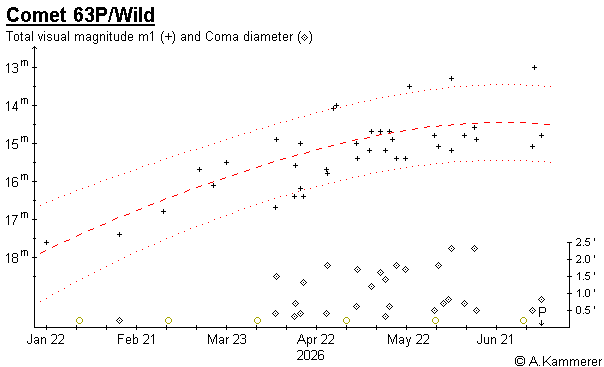
Comet 63P/Wild (P=13.46a) will pass perihelion on July 6, 2026 at a solar distance of 1.97 AU. It will move through the constellations Gemini, Cancer and Leo, and should therefore be observable in the evening sky with larger telescopes until the start of June. In June a maximum brightness of 15.0–15.5m is expected.
The observations (mostly done by using CCD) of the comet are highly inconsistent. Based on 45 observations from 16 observers the averaged brightness parameters are
m0=0.6 mag / n=16, though with a standard deviation of ±0.5 mag. Thus the comet peaked at approximately 14.5 mag (with an uncertainty of ±0.5 mag) in late June 2026. A minor, short-term brightness increase of about 1.2 mag within the near-nucleus region was detected by the Zwicky Transient Facility team on May 4. On May 7 the material appeared as a broad brightening about 20" from the nucleus (ATel 17798). Between late September and early October 2026 the comet is expected to get fainter than 16 mag. Between mid-April and mid-June 2026 the coma diameter increased from 1.0' (100,000 km) to 1.6' (175,000 km). No estimates of the degree of condensation are available. A short tail, whose orientation changed from WSW to WNW, was observed between mid-February and early June 2026.Total Brightness and Coma Diameter
--------------------
Comet 78P/Gehrels (P=7.22a) will appear in the morning sky in early August 2026 for mid-European locations, expected to be of magnitude about 12.5. During late summer / fall it will move from the constellation Taurus into the constellation Cancer. It will pass perihelion at a solar distance of 2.00 AU on June 25, 2026. According to Seiichi Yoshida's website, the brightness parameters are expected to be approximately m0=4.0m / n = 8. My own analyses of four apparitions yield very different parameters and brightness developments (log r versus dt). In the second half of October Earth will be near the comet's orbital plane.
By the end of July 2026 only a dozen observations of this comet had been published. These suggest brightness parameters of
m0 ≈ 8.0 mag / n ≈ 4.5. Thus the comet should show a fairly constant brightness of 13.5 mag between mid-August and mid-November 2026.--------------------
Comet 88P/Howell (P=5.48a) will pass perihelion at a solar distance of 1.36 AU on March 18, 2026. Unfortunately it will be close to the Sun for many weeks and cannot be seen from mid-European locations. Until the beginning of February 2026 only a few observations have been reported. These indicate a brightness of about 12.5 mag and a coma diameter of about 0.5' at the beginning of February, which is significantly fainter than the predictions. It must therefore be expected that the comet will reach a maximum brightness of only 11.0-12.0 mag.
The comet exhibited very different activity parameters pre- and post-perihelion. Pre-perihelion its activity virtually exploded, while post-perihelion it is declining at a significantly slower rate, though still distinctly above average. Based on 117 observations (mostly via CCD) from 19 observers (until mid-July 2026) the following brightness parameters can be determined:
pre-perihelion: m0 = -3.8m / n = 37 post-perihelion: m0 = +5.7m / n = 8.5 Thus the comet reached a maximum brightness of 10.0 mag around the days of perihelion. By the end of July 2026 it had faded to 13.0 mag. The coma diameter measured 0.5' (50,000 km) at the start of the apparition, reaching the maximum of 3.3' (275,000 km) by the end of April 2026. By the end of July it had shrunk to 1.5' (110,000 km). The degree of condensation was DC 2–3 at the start of the apparition, increasing to DC 4–5 by mid-May, thereafter decreasing to DC 2–3 by the end of July. A tail, consistently pointing toward WSW, was observed starting in late April, reaching a maximum length of 7' (just short of 1 mio. km) on CCD images.Total Brightness and Coma Diameter
--------------------
Comet 123P/West-Hartley (P=7.67a) will pass perihelion on Sep. 21, 2026 at a solar distance of 2.16 AU, expected to reach magnitude about 15. In March 2027 it is expected to reach a maximum brightness of 14.5 mag, thereafter fading to 16 mag by mid-July. During this period it will move through the constellations Leo, Virgo, Libra and back into Virgo. From mid-European locations it will appear above the eastern morning horizon in early October, and disappear above the southwestern evening horizon in late June 2027. Earth will cross the comet's orbital plane on Nov. 8.
--------------------
Comet 161P/Hartley-IRAS (P=21.46a) was rediscovered by three observatories between July 15 and 25, 2026 in its third apparition. Located in the southwestern corner of the constellation Eridanus the comet showed a strongly condensed 10" coma of total magnitude 18.5. The comet's orbit previously exhibited very large residuals, which have now been significantly reduced. It will pass perihelion on Nov. 27, 2026 at a solar distance of 1.27 AU. It will approach Earth to within 0.50 AU on Oct. 2 and could then reach a maximum brightness of 11.5 mag (CBET 5718). However, the brightness parameters are only known approximately. Furthermore, the comet's absolute magnitude appears to become fainter by every apparition. Assuming it evolves according to the parameters m0=11.0 mag / n=5 it should be brighter than magnitude 16 between August 2026 and March 2027. During this period it will move through the constellations Eridanus, Cetus, Aquarius (perigee), Equuleus, Delphinus, Aquila, Sagitta (perihelion), Vulpecula and Lyra. For mid-European locations it will appear above the southeastern horizon in the morning sky in early August, then shifting to the night sky and eventually into the evening sky during the following weeks. Starting in January 2027 it will once again be better visible in the morning sky.
--------------------
Comet 169P/NEAT (P=4.20a) will pass perihelion on Sep. 21, 2026 at a solar distance of just 0.60 AU, and could then reach magnitude 10.5. It will pass Earth on Aug. 15 at a distance of only 0.17 AU with a predicted brightness of 11.5 mag. The comet exhibits a high activity parameter. In consequence it could get fainter than magnitude 16 already by the end of October. During this period it will move through the constellations Canes Venatici, Ursa Major, Leo Minor, Leo and Sextans. As a result it can be observed from mid-European locations in the evening sky until around Aug. 20, and again in the morning sky starting in late September. On Sep. 20 Earth will cross the comet's orbital plane. If the comet should contain a significant amount of dust, forward scattering will cause a noticeable brightening around Aug. 28.
However, estimates published until the end of July 2026 suggest a rather low activity parameter, hinting towards a maximum brightness of only 13.5 mag.
--------------------
Comet 235P/LINEAR (P=6.40a) passed perihelion on Dec. 22, 2025, at a solar distance of 1.98 AU, significantly brighter than expected. The comet can be seen in the morning sky in spring 2026. It will move from the constellation Scorpius to the border of the constellations Ophiuchus/Serpens. On Apr. 11 Earth crosses the comet's orbital plane.
The comet exhibited a fairly high activity parameter during this apparition. Based on 153 observations (primarily using CCD) from 29 observers its brightness development can be well described by the parameters
m0 = 6.5 mag / n = 8. Thus the comet reached a maximum brightness of 14.0 mag in March 2026. By the end of July the comet became fainter than 16.0 mag. The apparent coma diameter was constant at 0.9' for an extended period, decreasing to 0.5' by the end of July. This resulted in a contraction of the absolute diameter from 90,000 km to 40,000 km between November 2025 and mid-May 2026, after which it remained constant. Concurrently, the degree of condensation decreased from DC 5–6 to DC 3–4. CCD observers detected a tail between mid-January and mid-June 2026, which reached a maximum length of 6' (1 mio. km) in spring 2026. During its visibility the tail's orientation shifted from p.a. 280° to p.a. 260°.Total Brightness and Coma Diameter
--------------------
Comet 240P/NEAT (P=7.59a) will pass perihelion at the solar distance of 2.12 AU on Dec. 19, 2025 and will be in opposition to the Sun at this time, near the border of the constellations Taurus and Aries.
The comet showed a surprisingly complex brightness behavior, as evidenced by 415 observations (mostly by CCD) from 46 observers. Furthermore, the observations can only be meaningfully simulated with time-dependent formulae. In mid-July 2025 and early February 2026 the comet was only of magnitude 15.0, peaking at 11.8 mag at the end of November 2025. It was not until 70 days before perihelion that the heliocentric brightness began to increase. The decline post-perihelion was less rapid than the increase in activity pre-perihelion. The brightness development can be represented as follows:
t < -70d: m = 13.0 mag + 5×log DTotal Brightness and Coma Diameter (Main Component)
FGK observations (Main Component)
On Oct. 3, 2025 images taken with the 2.25 m Bok reflector at Kitt Peak showed a fragment (B) located 74" west and 53" south of the main component (A). This fragment could be traced back to June 2025. While the main component had a brightness of 13.5 mag, a coma diameter of 1.1', and an 8.7' long tail towards p.a. 259°, fragment B had a brightness of 18.5 mag and a 0.2' long tail towards p.a. 273° (CBET 5622). Fragment B slowly drifted away from the main component and became brighter over several weeks. It reached maximum brightness of 13.8 mag around Dec. 5, 2025. According to 129 observations by 24 observers the fragment showed the following brightness development:Total Brightness and Coma Diameter of Fragment B
--------------------
Comet 260P/McNaught (P=6.90a) passed perihelion at a solar distance of 1.42 AU on Aug. 5, 2026. It is expected to remain brighter than magnitude 16 until mid-December 2026. During this period, it will move through the constellations Taurus, Perseus, and Auriga, making it an object visible in the morning sky. On Sep. 12 Earth will cross the comet's orbital plane.
At the end of July 2026 only two dozen observations are available for a preliminary analysis. These indicate brightness parameters of m0 ≈ 13.0m / n ≈ 4, which would indicate a maximum brightness of 14.7 mag in late August 2026. Current observations indicate a comet diameter of 0.5' (30,000 km). CCD observers report a tail extending toward the WSW with a length of up to 5' (300,000 km).
--------------------
An asteroidal object of magnitude 16.5, discovered on June 22, 2026 by the ATLAS team, was identified by H. Sato as a rediscovery of Comet P/2021 N1 (ZTF), which has an orbital period of 5.15 years. Comet P/2026 M1 (ZTF) was of magnitude 15.5, showing a 25" coma and a 2' tail at p.a. 250°. The comet will pass perihelion on July 28, 2026 at a solar distance of 0.97 AU, expected to reach magnitude 15.5 (CBET 5707). It had already passed Earth on June 29 at a minimum distance of 0.17 AU; on that day it was expected to peak at magnitude 14.5. It is expected to remain brighter than magnitude 16 until mid-August 2026. Between June 20 and mid-August it will move through the constellations Grus, Sculptor, Cetus (perigee), Pisces, Aries (perihelion) and Perseus. From mid-European locations it will appear above the eastern horizon in the morning sky in early July, thereafter rapidly gaining altitude.
Only about a dozen observations can be used for a rough analysis at the end of July 2026. These indicate a maximum brightness of just 15.5 mag at the end of June 2026. The brightness development can be represented quite well using the rough parameters m0 ≈ 19.0 mag / n ≈ 4.
--------------------
On images taken with the PANSTARRS-1 telescope on June 16, 2026 comet P/2006 HR30 (Siding Spring) was serendipitously rediscovered in the southern part of the constellation Sagittarius as an object of magnitude 20.5. Comet P/2026 M4 (Siding Spring) will pass perihelion of its orbit (period: 21.73 years) at a solar distance of 1.22 AU in early October 2028 and is expected to reach magnitude 12.5 (CBET 5708). It will reach its closest approach to Earth, at a distance of 0.99 AU, in early January 2029. The comet is expected to be brighter than magnitude 16 from mid-May 2028 through late April 2029. During this period it will move through the constellations Pegasus, Andromeda, Perseus, Giraffe, Lynx, Ursa Major (perihelion), Leo Minor, Leo, Sextans (perigee) and Hydra. For mid-European locations it will appear above the eastern morning horizon in mid-May and quickly gain altitude. Between August and November 2028 it will be high in the morning sky. Thereafter its altitudes will decrease. At that time it will first become an all-night object and eventually an object in the evening sky.
Andreas Kammerer