Home=Current Comets: C/2025 R3
| The German Group
| Tutorials
| Archive
| Projects, publications
| Images
| Contact
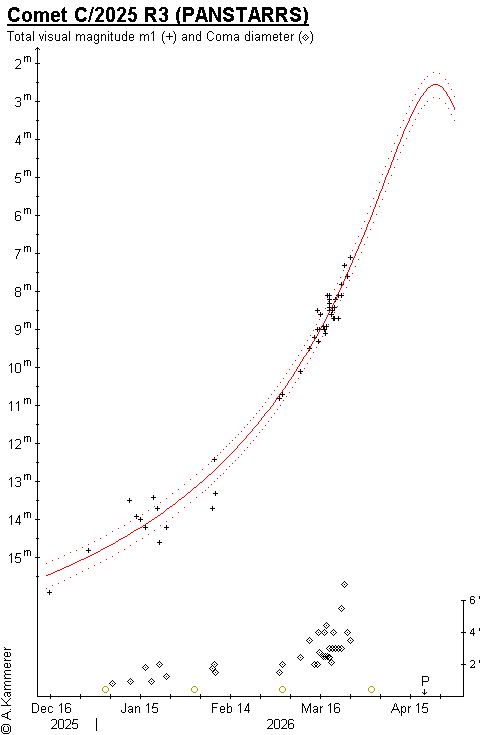
On Sep. 8, 2025, the PANSTARRS team discovered an additional comet, this time in the constellation Andromeda. Comet C/2025 R3 (PANSTARRS) showed a condensed 5" coma of total magnitude 19.5 and a broad 10" tail in p.a. 165-225°. The comet will pass perihelion at a solar distance of 0.50 AU on Apr. 19, 2026, expected to peak at 9 mag if it shows an average development (CBET 5607). It is expected to be brighter than 16 mag between February and June 2026. During this period it will move through the constellations Pegasus, Pisces (perihelion), Cetus, Taurus, Eridanus, Orion, Monoceros, and Canis Major. From Central European locations the comet can only be observed in the evening sky until mid-February 2026 and just above the eastern horizon in the morning sky between early March and mid-April. However, the absolute magnitude, as derived from published observations, is 2 mag below the Bortle-limit. Thus there is a certain probability that the comet will disintegrate on its way to the Sun. If the comet survives its perihelion without major damage, J. Marcus' formulae predict that there will be significant forward scattering in the second half of April, which could increase its brightness by up to 6.5 mag on Apr. 26! However, the comet will only be 5° from the Sun on that day. Earth will cross the comet's orbital plane on Apr. 29.
Despite its rather low absolute magnitude the comet survived its small perihelion distance. Based on 419 observations from 75 observers (until the end of July 2026) the comet showed a different brightness behavior pre- and post-perihelion. Activity declined more slowly post-perihelion than it had increased pre-perihelion, and the absolute brightness post-perihelion is nearly one magnitude brighter than pre-perihelion. The brightness parameters outside the 10-day period during which forward scattering was significant are as follows:
t < 0d: m0 = 8.4 mag / n = 4.3This results in a maximum brightness of 3.5 mag on Apr. 26, 2026. During the first 10 days after perihelion the comet could only be observed by satellites (primarily SOHO and CCOR). The values derived from these observations indicate a maximum brightness of 1.5 mag, due to forward scattering. This brightening, caused by dust particles, resulted in an short-lived increase of 2.0 mag. This remained below the theoretical maximum value (6.5 mag), as the comet contained only a small amount of dust. By May 10 the comet had faded to 6.0 mag and by end of June, when the comet became unobservable, to 11 mag.
Total Brightness and Coma Diameter
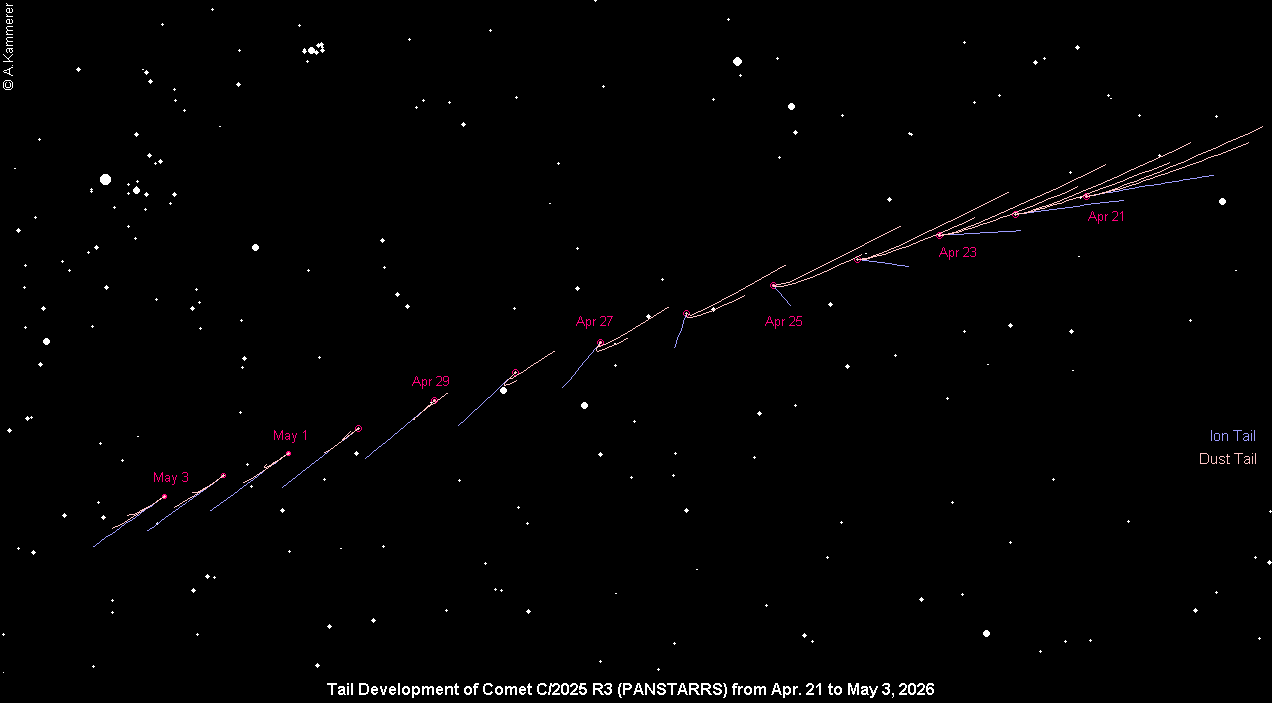
The apparent coma diameter remained fairly constant at short of 1' at the start of the apparition. From mid-March onward it increased significantly, reaching a maximum of short of 10' around Apr. 20, 2026. Post-perihelion the apparent coma diameter decreased continuously to 2.0' until end of June. The absolute coma diameter measured 150,000 km at the start of the apparition, then, starting in mid-March, it increased significantly, reaching a maximum of 325,000 km in early April 2026. By end of June it had decreased to 150,000 km. At the start of the apparition the coma appeared quite diffuse (DC 3), but, starting in mid-March, it rapidly condensed, reaching a maximum of DC 8 around April 15. Post-perihelion the degree of condensation decreased to DC 4-5 by end of June. A tail was reported between mid-March and end of June 2026. It reached a visual length of 6° (12 mio. km) around May 8. The position angle of the tail decreased from 320° to 280° between mid-March and April 20. Post-perihelion it was constantly directed towards 130°.Post-perihelion I predicted an interesting tail morphology for several days, as shown in the following diagram.
Simulation of the Tail Development
Andreas Kammerer