Home=Current Comets: 24P (2025/26)
| The German Group
| Tutorials
| Archive
| Projects, publications
| Images
| Contact
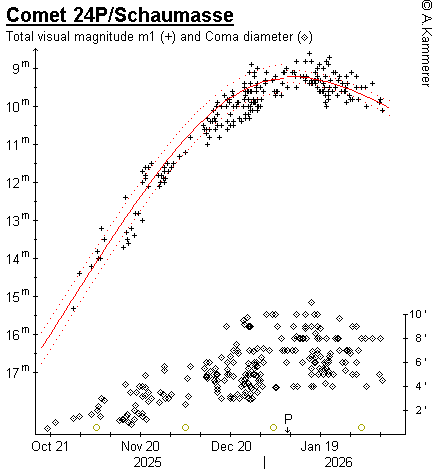
During the winter months 2025/26 comet 24P/Schaumasse (P=8.18a) should become an object that should be easily visible through a telescope and probably even in binoculars. It will pass perihelion at a solar distance of 1.18 AU on Jan. 8, 2026. On Jan. 4, 2026 it will come to within 0.59 AU to Earth. There are different approaches concerning the brightness parameters. While a high activity parameter of n = 12 is generally assumed, values between m0 = 7.5 mag and m0 = 9.5 mag are discussed for the absolute magnitude. Accordingly, the brightness should increase from 13 mag (11 mag) in mid-November 2025 to 10.5 mag (8.5 mag) in early January 2026, thereafter fading to 11.5 mag (9.5 mag) by mid-February. During the winter months of 2025/26 the comet can be observed in the morning sky. It will move from the constellation Cancer to the border of of the constellations Bootes/Virgo, where it will reach its maximum brightness of 10.5 mag (possibly 8.5 mag). The Earth will cross the comet's orbital plane on Dec. 10.
The comet showed rather high activity parameters both pre- and post-perihelion, with the activity increasing more rapidly pre-perihelion than decreasing post-perihelion. At the end of October 2025 the brightness was only 15.0 mag, while at the beginning of May 2026 the comet was still 13.5 mag bright. The comet got fainter than 16.0 mag in mid-June. Based on 592 observations by 64 observers the brightness parameters are as follows:
pre-perihelion: m0 = 7.6 mag / n = 17The comet thus reached a maximum brightness of 9.4 mag around Jan. 10, 2026. Two minor short-term increases in brightness of the near-nucleus region were recognized by the Zwicky Transient Facility team on Mar. 19 (increase of 0.7 mag) and on May 10 (increase of 1.1 mag) (ATel 17799).
Total Brightness and Coma Diameter
While the coma measured only 1.5' (60,000 km) at the end of October 2025, it grew to a maximum of 10' (260,000 km) by mid-January 2026. Post-perihelion the coma diameter decreased rather rapidly until mid-April (2.5' = 100,000 km) thereafter significantly slower. By mid-July it measured just 0.8' (80,000 km). The coma was always rather diffuse, with a faint central condensation discernible. The degree of condensation remained constant at DC 3-4 until mid-March 2026, decreasing to DC 1 by mid-June. CCD observers noted a tail consistently pointing toward WNW between late December 2025 and early May 2026, which reached a maximum length of 9' (350,000 km) in early February 2026.Andreas Kammerer