Home=Current Comets: 220P (2026)
| The German Group
| Tutorials
| Archive
| Projects, publications
| Images
| Contact
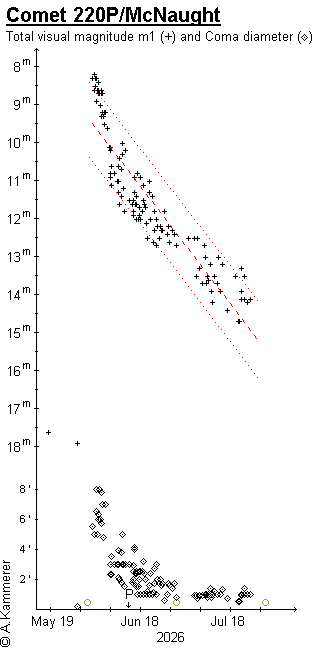
Comet 220P/McNaught (P=5.51a) increased its brightness by nearly 10 magnitudes between May 30.59 UT and May 31.15 UT! At only magnitude 17.5-18.0 before the major outburst, it reached maximum brightness of 8.3 mag on June 3. An image taken by Gerald Rhemann and Michael Jäger on that date shows a strongly condensed coma with an apparent diameter of 6.5'. An image taken by the two amateurs the previous day (captured with a 30-cm telescope at Tivoli Farm) shows a faint ion tail more than 2° long (CBET 5698). Immediately after the outburst the comet began to fade very steadily, according to a time-dependent formula - typical for comets undergoing an outburst. Based on 124 observations from 29 observers the brightness development after the outburst can be well described by the formula
m = 9.8 mag + 5×log D + 0.11×(t - T)By the end of July the comet had faded to 15 mag.
Total Brightness and Coma Diameter
In parallel to the rapid fading the coma shrank from short of 8' (525,000 km) on June 3 to only 0.8' (60,000 km) on July 25. During the same period the degree of condensation decreased from DC 6 on June 3 to DC 2 by the end of July. A tail, consistently directed toward p.a. 250°, was observed between June 3 and July 20, reaching a maximum length of 0.5° (3 mio. km) around June 20.Narrow-band photometry with the TRAPPIST telescope derived the following production rates (molecules/s): June 5 (r = 1.56 AE, dT = -9d): OH: 8.4×1027, CN: 3.0×1025, C2: 5.5×1025, Dust: Af(rho) = 2035 cm, June 6 (r = 1.56 AE, dT = -8d): OH: 6.5×1027, CN: 2.3×1025, C2: 4.0×1025, Dust: Af(rho) = 1915 cm. Thus a sharp drop of the production rates within a very short period is evident (ATel 17838).
Andreas Kammerer