Home=Current Comets: 10P (2026)
| The German Group
| Tutorials
| Archive
| Projects, publications
| Images
| Contact
Comet 10P/Tempel (P=5.36a) will pass perihelion on Aug. 2, 2026, at a solar distance of 1.42 AU. It will pass Earth at a distance of 0.41 AU on Aug. 4. It is expected to become brighter than 16 mag in March/April. Until mid-August it will move from the constellation Aquila to the constellation Piscis Austrinus. Thus it is an object in the morning sky at first, but will be visible for the whole night thereafter. The comet has an absolute magnitude of 8.0-9.0 mag and a high activity parameter (n = 10-12). It should brighten from 14.0 mag in May to the maximum of 10.0-11.0 mag. During the second half of July Earth will be situated near the comet's orbital plane.
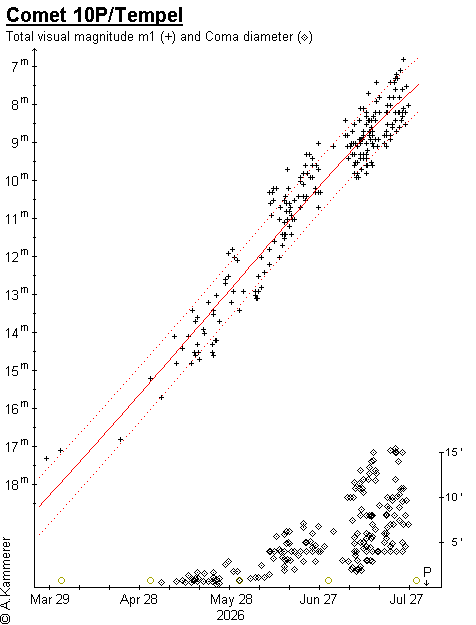
The comet typically exhibits a very diffuse coma and a brightness development that includes time-dependent terms. This involves a rapid increase in brightness up until shortly before perihelion, followed by a phase of approximately 30 to 50 days with constant heliocentric brightness, which in turn is followed by a significantly slower decline in activity (compared to the period before perihelion). At the end of July 2026 249 observations from 57 observers can be used for the analysis. These can be reasonably well represented by the formula
m = 9.2 mag + 5×log D + 0.065×|t – T|Alternatively, the formula
m = -0.3 mag + 5×log D + 69×log rcan be applied, though with a significantly lower correlation coefficient. Assuming that the comet again exhibits a phase of constant heliocentric brightness during this apparition, lasting approximately 30 to 50 days, a maximum brightness of 7.5-8.0 mag results, which is likely to remain fairly constant for an extended period. By mid-November the comet should have faded to 11–12 mag.
Total Brightness and Coma Diameter
In parallel to the rapid brightening (between start of April and end of July from 17.5 mag to 7.5-8.0 mag) the coma's diameter increased from 0.5' (25,000 km) in early May to just under 15' (275,000 km) in late July. The coma appears quite diffuse. The degree of condensation ranges between DC 3 and DC 4. It is difficult to determine the exact value because, on the one hand, the coma is very diffuse in general, but on the other hand, it exhibits a significantly brighter inner region with a central condensation. Some CCD observers have reported a tail pointing toward the WSW since late June, which has so far reached a maximum length of about 0.5° (app. 2 mio. km).Andreas Kammerer